The Digital Renaissance: A Journey Through the Evolution of Technology

Written by
Ahinsree BPublished
December 31, 2025Reading time
3 min read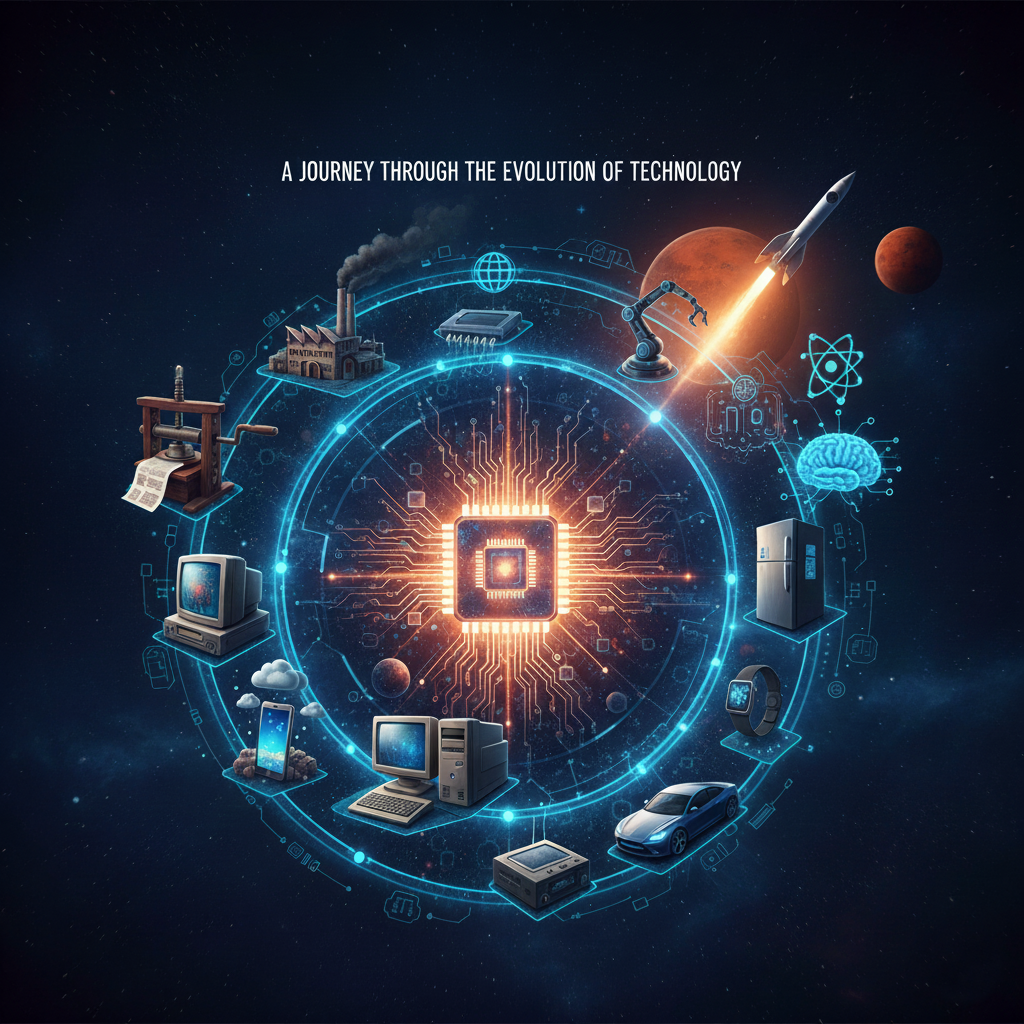
Audio Experience
Listen to this insight in your language
The story of human civilization is, at its core, the story of our tools. From the moment the first hominid sharpened a flint stone to the current era of generative AI, technology has been the primary engine of our evolution.
But how did we get from “fire and wheels” to “fiber optics and quantum bits”? Let’s take a walk through the major epochs of technological history.
1. The Pre-Digital Foundations (Pre-1800s)
For millennia, technology was mechanical and muscle-powered. The printing press (1440) was perhaps the first “information revolution,” democratizing knowledge and setting the stage for the Renaissance. Later, the Industrial Revolution swapped human and animal labor for steam and coal, scaling production in ways previously unimaginable.
2. The Age of Electricity and Telecommunications (1800s – 1940s)
The 19th century sparked a global “connection.” The invention of the telegraph allowed information to travel faster than a horse for the first time in history.
- 1876: Alexander Graham Bell transmits the first telephone call.
- 1880s: Thomas Edison and Nikola Tesla transform the world with electrical grids.
- 1920s: Radio becomes the first mass media, bringing the world into people’s living rooms.
3. The Birth of the Computer (1940s – 1970s)
World War II accelerated the need for complex calculations. This led to ENIAC, the first general-purpose electronic computer. These early machines were massive, filling entire rooms and using vacuum tubes that generated immense heat.
By the late 1950s, the transistor replaced vacuum tubes, allowing computers to become smaller, more reliable, and significantly more powerful. This was the “Big Bang” moment for modern electronics.
4. The Personal Computing & Internet Revolution (1980s – 2000s)
Technology moved from the basement of government buildings to the top of our desks. Companies like Apple and Microsoft made the “Personal Computer” (PC) a household staple.
The real game-changer, however, was the Internet.
- The 90s: Dial-up modems and the World Wide Web turned the globe into a digital village.
- The 2000s: Broadband replaced dial-up, and the “Social Media” era began, redefining how we interact, shop, and perceive reality.
5. The Mobile and Cloud Era (2010s – Present)
In 2007, the iPhone launched, effectively putting a supercomputer in everyone’s pocket. We shifted from “going online” to being constantly connected.
- Cloud Computing: Data moved from local hard drives to remote servers, enabling seamless syncing and “Software as a Service” (SaaS).
- The Internet of Things (IoT): Our fridges, watches, and cars started talking to each other.
Where Are We Now? The “Intelligence” Frontier
Today, we are entering the era of Artificial Intelligence (AI), Robotics, and Quantum Computing. Unlike previous eras where tools simply followed our instructions, modern technology can now learn, predict, and create. We are no longer just building better hammers; we are building “thinking” partners.
| Era | Key Driver | Impact |
| Industrial | Steam/Coal | Physical Scaling |
| Information | Silicon/Internet | Global Connectivity |
| Intelligence | Data/Neural Networks | Automated Decision Making |
Conclusion
The evolution of technology is not just about gadgets; it’s about the expansion of human potential. As we look toward a future of Mars missions and sustainable energy, one thing remains constant: our relentless desire to innovate.
About Ahinsree B
Building systems for wealth, career, and communications. Dedicated to helping professionals architect a life of freedom and influence.
Inside the Issue
35% through